
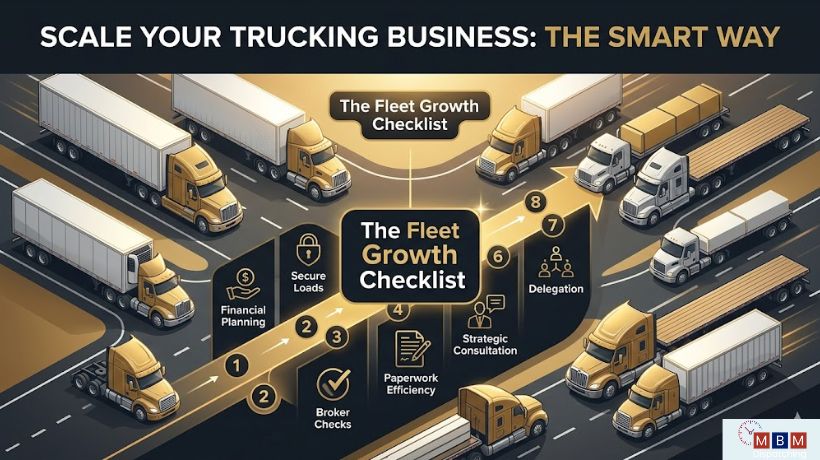
The Fleet Growth Checklist
Every Truck Owner Needs
You own a truck. Maybe two. Somewhere in the back of your mind, there’s a bigger vision — more trucks, more loads, more money. But here’s what most owners never hear: growing a fleet isn’t just about buying more trucks. It’s about building the right systems first — because without those, every truck you add just multiplies your problems, not your profits.
Fleet Strategy
8 min read
April 2026
Loads Delivered
Avg. Monthly Client Earnings
States Covered
This checklist is your roadmap. Whether you’re running one truck or five, these are the steps that separate owner-operators who stay stuck from those who actually build thriving trucking businesses. Work through each one honestly — plug the gaps — and watch what happens when you finally have the right foundation under you.
Know Your Numbers Before You Grow
Growth without numbers is just guessing. Before you add a second or third truck, you need to know your cost per mile (fuel, maintenance, insurance, tires), your average revenue per load, and your monthly net profit per truck.
If you can’t answer those off the top of your head, disorganized financials are silently eating your growth potential. Get your systems tight first — scaling a leaky operation only makes the leak bigger.
Secure Consistent, High-Paying Loads
One truck sitting empty costs you money. Three trucks sitting empty can sink your business. Before you scale, you need a reliable load pipeline — not spot market scrambling on load boards every morning. This means building relationships with quality brokers, knowing which lanes pay best for your equipment, and having a dispatch partner who’s actively hunting loads for your trucks every single day.
Top-earning carriers all share one common factor: who’s finding their freight. Don’t miss this essential read on what that really looks like in practice.
Vet Every Broker Before You Haul
This one gets skipped constantly — and it costs carriers thousands of dollars. Not every broker who calls is financially reliable. Some have a history of delayed payments, disputes, or outright defaults. As you scale and take on more volume, that risk multiplies fast.
Before committing to any load with a new partner, run a broker credit check. It takes minutes and can save you from hauling freight you never get paid for. No excuses for skipping this step.
Get Your Paperwork and Invoicing Airtight
A lot of carriers leave serious money on the table — not because they aren’t hauling enough, but because their invoicing is slow, inconsistent, or full of errors. When you’re running one truck, you can manage paperwork yourself. When you’re scaling to three, five, or ten trucks? Every missed invoice and every billing error compounds.
Getting your paperwork and invoicing handled professionally means you get paid faster, stay fully compliant, and free yourself up to focus on actually growing the business instead of chasing down signatures and rate confirmations.
Diversify Your Equipment and Load Types
One of the smartest moves a growing fleet owner can make is not putting all their eggs in one basket. If you’re running dry van only, what happens when your lanes soften or rates drop? The most resilient carriers run a mix — dry van, reefer, flatbed, power only — so they can pivot when the market shifts.
Each equipment type opens up entirely different load networks and revenue streams. If you’re running flatbed or thinking about adding reefer to your fleet, these two reads are essential before your next move.
Build a Growth Strategy — Not Just a Work Schedule
Most truck owners are busy. That’s not the same as being strategic. A real fleet growth strategy means knowing which lanes you’re targeting, whether you’re building authority carrier status, what your rate-per-mile target is for each equipment type, and how you plan to manage drivers as you grow beyond one or two trucks.
This is where expert business consultation pays for itself many times over. Having someone who truly understands the trucking industry review your setup, identify your blind spots, and map a realistic growth plan can shave years off your learning curve.
Put the Right Logistics Support in Place
Growing a fleet means more moving parts — more drivers, more lanes, more loads to coordinate simultaneously. Without the right logistics infrastructure, things fall through the cracks fast: missed pickups, compliance issues, inefficient routing, unhappy shippers.
Smart fleet owners invest in logistics consultation before things break down, not after. The goal is to build operations that scale cleanly — with every truck in your fleet running efficiently and profitably, not just busy.
Stop Operating Like a Solo Driver
This is the mindset shift that changes everything. When you own one truck, you are the business. When you own three, five, or ten — you need to think like a business owner, not just a driver. That means delegating, systematizing, and building a team around you instead of trying to do it all yourself.
The carriers growing fastest right now aren’t doing it alone. They have a solid dispatch team handling load boards, a clean back office managing their paperwork, and expert support dealing with brokers and compliance. That’s not a luxury. That’s the model. That’s the edge.
Ready to Scale Smarter?
Join thousands of carriers who’ve stopped guessing and started growing — with the right systems, the right loads, and a dispatch team that works as hard as you do.