
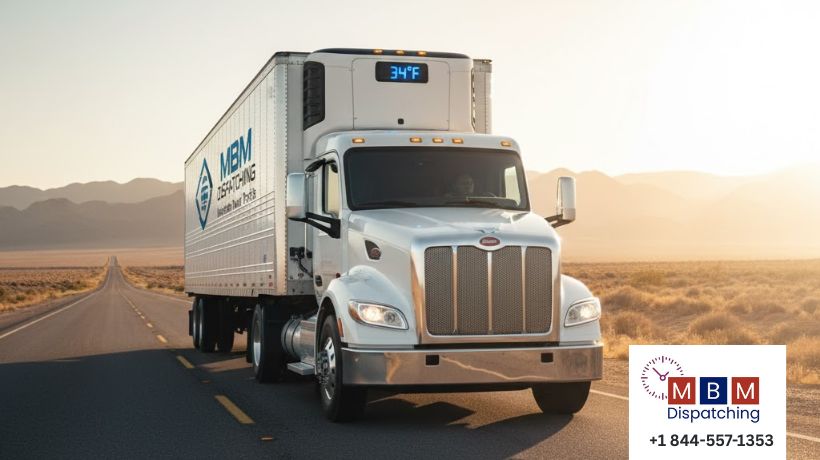
If you’re pulling a refrigerated trailer, you aren’t just a driver—you’re a mobile pharmacist and a grocery supplier. One wrong setting or a four-hour delay at a receiver can turn a $4,000 payout into a $40,000 claim.
To maximize profits in reefer trucking, you have to move beyond “finding loads” and start mastering yield management. This guide explains how specialised dispatching turns temperature-controlled logistics into a high-margin business.
How Much Can a Reefer Owner-Operator Actually Earn?
A ubiquitous question People Ask is: Is reefer trucking more profitable than dry van?
The answer is yes, but only if your revenue per mile offsets the higher operating costs (reefer unit fuel, washout fees, and higher insurance premiums). At MBM Dispatching, our reefer clients average $41,000 in monthly gross earnings. We achieve this by targeting a high Cents Per Mile (CPM) that accounts for the specialised nature of the freight.
Pro Tip: Don’t just look at the rate on the screen. A $3.00/mile load that takes 6 hours to unload without detention pay is actually a lower-paying load than a $2.50/mile load with a “drop and hook” or guaranteed detention.
Strategic Solutions for the Most Common Reefer Pain Points
1. Eliminating “Lumper” and Detention Headaches
Reefer drivers spend a disproportionate amount of time at grocery warehouses. If your dispatcher isn’t fighting for detention pay and lumper reimbursements upfront, you are working for free.
- The MBM Strategy: We verify lump-sum policies before you accept the rate contract. We ensure detention begins at the 2-hour mark, protecting your clock and wallet.
2. Managing the “Deadhead” Trap
Reefer freight is often directional (e.g., produce coming out of Florida or California). The mistake many new carriers make is accepting a high-paying load into a dead zone without a plan to exit.
- The Insight: Profit is measured by the Round Trip Average, not the head-haul rate. We look two loads ahead to ensure you aren’t stuck hauling “cheap air” just to get back to a good lane.
3. Real-Time Risk Mitigation
In reefer trucking, “hassle-free” means having a back office that performs Broker Credit Checks in real-time. If a broker has a “C” rating for paying reefer claims, we move on. Your financial security is the foundation of your profit.
[Also read About “Stop Searching Loads—Work With a Trusted Dispatcher” Last week, we revealed the secret to cutting empty miles by 30%—read the full breakdown here to see how we keep our carriers moving.]
Why spend 4 hours a day on load boards competing with thousands of other drivers for the same “bottom-of-the-barrel” rates? When you partner with a dedicated dispatcher, you aren’t just buying a service; you’re hiring a negotiator who knows the brokers, the lanes, and the fair market value of your equipment.
The “Freedom-First” Business Model
Most carriers fear long-term contracts because they feel like they’re losing their independence. We believe the opposite: Support should give you more freedom, not less.
- No Long-Term Contracts: We earn your trust every week. If we don’t perform, you aren’t locked in.
- You Are the Boss: You choose the loads. If a route doesn’t fit your schedule or your home-time needs, we find one that does.
- US-Based Support: No communication gaps. Our team understands the nuances of US DOT regulations and the specific challenges of New York traffic or West Coast inspections.
Skip the wait and book a 15-minute introductory call with a Dispatch Specialist. We’ll discuss your equipment, lanes, and how to get started with your 7-Day Free Trial.
People Also Ask: FAQ for Reefer Maximisation
Q: What is the average fuel consumption for a reefer unit?
Typically, a reefer unit consumes between 0.4 and 1.1 gallons per hour, depending on the “start/stop” vs. “continuous” setting. We factor these “hidden costs” into our negotiations to ensure your take-home pay remains high.
Q: How do I handle a rejected load?
Rejected reefer loads are a nightmare. Our back-office support handles immediate communication with the broker and insurers, often identifying “distressed load” buyers or food banks to minimise your downtime.
Q: Can I haul dry freight in a reefer?
Yes, and sometimes you should! If reefer rates are low in a specific region, hauling dry freight is a great way to stay moving and minimise deadhead. We monitor both markets to give you the best options.
Take the MBM Challenge
You deserve a partner who is as committed to your bottom line as you are. Whether you are a New York carrier navigating the Northeast or a long-haul specialist, our expertise in Flatbed, Dry Van, and Reefer logistics is designed to scale your business.
Ready to see the difference?
7-Day Free Trial: Experience our premium dispatching with zero risk.
Schedule Your Consultation Now: Let’s review your current numbers and identify an additional $2,000 in weekly revenue.
Call us now: +1 844-557-1353
or email info@mbmdispatching.co
Headquarters: 7901 4th St N STE 6123, St. Petersburg, FL 33702, United States.